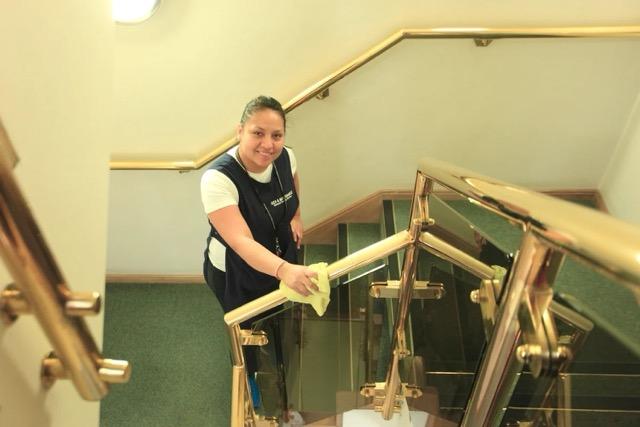
Most London offices are cleaned when nobody is there. Staff leave a tidy-ish office in the evening and arrive to clean desks, empty bins and fresh washrooms in the morning. That's the point of out-of-hours cleaning: the work gets done without vacuums running through meetings or cleaners working around people at their desks.
If you're setting up a contract for the first time, or wondering whether your current schedule is the right one, this guide explains how out-of-hours cleaning works in practice: the choice of shifts, how access and security are handled, and how to keep standards high when you rarely see the people doing the work.
What counts as out of hours?
Out-of-hours cleaning simply means cleaning outside your normal working day. In practice there are three options, and many offices use more than one.
Early morning
The team arrives before staff, often finishing by the time the first people come in. The main advantage is that the office is at its best at the start of the day. Kitchens are clean, bins are empty and any overnight mess is dealt with. The trade-off is a fixed deadline. If your building opens early or some staff start at 7am, the window can be tight.
Evening
Cleaners arrive once most staff have left. Evenings usually allow more time, so they suit larger offices and longer task lists. The drawback is that a busy day can leave the kitchen and washrooms untidy again by mid-morning, and people working late may still be at their desks.
Weekends
Weekends are rarely used for routine cleaning but are ideal for work that takes longer or needs the space empty, such as deep cleans, carpet cleaning and floor care. Carpets cleaned on a Saturday have the rest of the weekend to dry before Monday.
For most offices, the routine daily cleaning happens early morning or evening, with periodic work booked for weekends.
Access and security
Letting a cleaning team into an empty office is a matter of trust, so it should be handled formally from day one.
- Keys and fobs: keep a written record of every key, fob and access card issued, who holds it and when it was handed over.
- Alarm codes: give the team their own code if your system allows it, so entries and exits can be traced. Change codes when a contract ends.
- Building management: in a managed or shared building, tell reception or security who the cleaners are and when they'll arrive. Some buildings ask contractors to sign in or carry ID.
- Restricted areas: be clear which rooms are off limits, such as server rooms, and whether any rooms should be cleaned only when someone is present.
- Locking up: agree who checks windows, turns off lights and sets the alarm, and what to do if the alarm can't be set.
Ask your provider how their staff are vetted. GCS Maintenance cleaning staff are DBS-checked, and we're fully insured.
What happens on a typical visit
A routine out-of-hours visit follows a written specification agreed for your site. For a typical office, that includes:
- Emptying all bins and recycling, and replacing liners
- Cleaning and restocking toilets and washrooms
- Cleaning the kitchen, including worktops, sinks, appliances and floors
- Wiping clear desks and high-touch points such as handles, switches and lift buttons
- Vacuuming carpets and mopping hard floors
- Tidying reception and meeting rooms
- Rotating weekly tasks, such as dusting skirting boards or cleaning internal glass
The specification should also say what isn't done, for example whether cleaners move papers on desks. That avoids misunderstandings on both sides.
Noise and people working late
Even with evening cleaning, some people will still be at their desks. Agree a simple approach: the team starts in empty areas and the kitchen, and leaves occupied areas until last. If people regularly work late in a particular room, you may choose to have it vacuumed in the morning instead.
For noisy or longer jobs, such as machine scrubbing or carpet extraction, book a weekend or a late evening when you know the office will be empty.
Staying in touch when you never see the team
The biggest challenge with out-of-hours cleaning is communication. You may go weeks without seeing your cleaners, so set up a channel that works without meeting in person:
- A named contact at the cleaning company who responds during the working day
- A communication book or shared log where either side can leave notes
- A clear way for the team to report problems they find, such as leaks, broken fittings or a fridge that has stopped working
- Advance notice of anything unusual, such as an event, a delivery or a room out of use
Cleaners are often the first to spot a dripping tap or a damaged ceiling tile. If your provider also offers general maintenance, those reports can be turned into repairs without you having to find a separate tradesperson.
Checking quality without being there
You don't need to stay late to know whether the cleaning is up to standard. A few habits are enough:
- Walk the office first thing once or twice a week, especially kitchens and washrooms
- Look at the places that are easy to skip: under desks, corners and the tops of cupboards
- Report problems promptly and specifically, with the room and a photo if possible
- Ask your provider how their supervisors check the work and how often
- Review the specification every few months as your use of the office changes
Periodic and specialist work
Out-of-hours working really pays off for the jobs that would be disruptive during the day:
- Deep cleans, which take longer and involve moving furniture
- Carpet cleaning, which needs drying time before people walk on the carpet again
- Hard floor scrubbing and polishing
- Internal glass and high-level dusting
Health and safety for out-of-hours cleaners
Cleaning an empty office often means working alone. Your cleaning contractor is responsible for assessing the risks to their staff, including lone working, but you can help by making sure:
- Corridors and stairs are lit, or lights are easy to find
- The team knows the fire alarm procedure and exits
- Cleaning chemicals are stored safely in a lockable cupboard
- Any building hazards, such as a broken step, are reported to them
Questions to ask a provider
- Which times can you cover, and how fixed are they?
- How are keys, fobs and alarm codes managed?
- How are your staff vetted, and are you insured?
- Who do we contact during the day, and how quickly do you respond?
- What happens if a cleaner can't make a shift?
- How do supervisors check the work?
If you're changing provider at the same time, our guide on switching office cleaning contractors covers the handover step by step.
Out-of-hours cleaning with GCS Maintenance
We schedule our office cleaning around your working hours, including early mornings, evenings and weekends. Tell us how your office runs and we'll suggest a schedule that fits.
This article is general guidance. Every office is different, so cleaning and maintenance needs will vary from site to site.